
What are the benefits of connecting to nature? Is this supported by scientific evidence? What are strategies to communicate this knowledge? This learning module will address these questions and more.
We begin by exploring how the opportunity for nature connection and the health of our population is being threatened by a changing climate, urbanization, and the COVID-19 pandemic. Then we examine the incredibly wide breadth of scientific research behind the mental and physical health benefits of connecting to nature. As healthcare professionals, we have the opportunity to not only advocate for increased accessibility to nature for our communities’ health, but also, to motivate our patients through evidence-based communication.
The goal of this learning module is to empower you to understand the specific health benefits of connecting to nature and how to share them with your community, your patients and yourself.
Chapters
1.
Current Challenges
2.
Health Benefits
3.
Practical Strategies
4.
Evidence to Action
1: Current Challenges
This section outlines some of the current challenges that our population faces and how we can look to nature as part of the solution.
In addition to the mental and physical distress related to climate change, Canada is already facing the concurrent challenge of an increasing prevalence of chronic diseases and mental health disorders. [1] In recent years 44% of adult Canadians had at least 1 of 10 common chronic dieases, and 20% of Canadians have experienced a mental illness. [2,3]
The looming threat of climate change only threatens to exacerbate these issues. The Lancet Planetary Health has declared climate change to be one of the greatest threats to global health in the 21st century, and there is an increasing level of awareness as to how it negatively impacts health. [4]
This section acts to provide information on the concurrent threats to overall human well-being, including: climate change, urbanization, COVID-19 pandemic, physical inactivity, sedentary behaviour, and loneliness.
By reviewing the challenges, we aim to highlight the need for nature connection and demonstrate how we can turn to nature to mitigate threats.
Urbanization, physical inactivity, & sedentary behaviour
In Canada, movement away from rural to urban areas continues to increase, with over 80% of the population now living in cities. [5] Urbanization is associated with increased levels of mental illness, and is associated with less opportunity to connect with nature on a regular basis. [6,7,8]
This is of high importance as only about half of children and adults get the recommended amount of physical activity, and fewer than 1 in 5 Canadian adults meet the sedentary behaviour recommendations. [9]
Surrounding green space has been associated with improved mental health and well-being, highlighting the importance of ensuring accessibility to nature in urban environments, and encouraging, and communicating different ways to connect to nature on a regular basis. [10]
Loneliness, Mental Health, & the COVID-19 Pandemic
Considering the increasing amount of urbanization, integration of technology, and use of social media, it is without surprise that even prior to the COVID-19 pandemic, levels of loneliness were on the rise. 1/5 of Canadians identified as being lonely, and over 40% of older adults experienced loneliness. [11] The importance for our population to connect to nature is apparent, and this can lead to increasing feelings of social cohesion, connection, and a reduced sense of loneliness. [12, 13, 14] Further, according to a study by the Canadian Mental Health Association (CMHA), mental health amongst Canadians has deteriorated by 40% since the onset of the pandemic, especially amongst the most vulnerable groups such as adolescents, indigenous peoples, women, and disabled peoples. Specifically, this CMHA study found anxiety levels reported to have increased by 48% and stress levels by 38% since the onset of the pandemic. [15]
Specific challenges to the well-being of healthcare professionals
As healthcare professionals, there are unique challenges that we face towards our well-being.
Two of the most notable are physician burnout and depression.
From the mental health impacts of a changing climate, to the COVID-19 pandemic and a highly demanding profession, it is vital to advocate for our own health and opportunities to achieve an appropriate work-life balance.
A national survey of Canadian ER physicians prior to the COVID-19 pandemic found an alarming 86% of respondents met the threshold for burnout, and 14% reported having contemplated suicide in their career. [16] Despite there being reports of high resilience and well-being amongst physicians, the Canadian Medical Association National Health Survey found the following:
- 30% of respondents reported experiencing burnout (defined by high emotional exhaustion and/ depersonalization)
- 34% of respondents experienced depression
- 1/10 respondents thought of suicide over the past year
- Highest rates of burnout and depression found amongst residents, doctors within their first 5 years of practice, and females. [17]
Increasing awareness about the health benefits of connecting to nature amongst healthcare practitioners and advocating for increased green spaces within and near the workplace to facilitate nature connection as a strategy is a good place to start.
Chronic Environmental Stressors of Climate Change on Mental Health
The impact of acute extreme weather events such as flooding or wildfires on mental health is a relatively well-studied entity that receives a lot of attention. However, more chronic environmental stressors, such as prolonged drought, changing weather patterns, and loss of meaningful landscapes and their negative impacts on mental health are much more unfamiliar and difficult to recognize due to their insidious nature and temporal dispersion. As discussed above, there is an alarming increase in the Global Burden of Disease of mental health disorders worldwide, especially anxiety and depression. As these rates continue to increase so does the increasing incidence of environmental change. It is crucial that healthcare practitioners begin to learn how to identify and understand both acute and chronic environmental stressors and their negative impacts on communities’ and individuals’ mental health.
This section introduces concepts that help to give greater meaning and understanding of the psychological impact of chronic environmental stressors. Australian environmental philosopher, Glenn Albrecht created the term “psycho- terratic” states to define earth-related mental illnesses where people’s mental well-being (psyche) is threatened by the severing of ‘healthy’ links between themselves and their home territory. [18] This term allows us to better understand certain emotional states such as loss of control and identity, hopelessness, loss of sense of “place”, distress from inability to derive solace from home environment and more.
Concepts developed to give greater meaning and understanding to Chronic Environmental Stressors:
- Solastalgia
- Ecological Grief
- Eco – Anxiety
- Eco – Paralysis
Examples of Chronic Environmental Stressors:
- Strain of hotter temperatures, drought, water shortages, food shortages
- Changes in weather patterns
- Distress of job losses and income reductions
- Loss of meaningful landscapes, such as changes to home environment
- Distress from loss of sense of “place”
- Impacts of illness and disease
Ecological Grief
The grief felt in relation to experienced or anticipated ecological losses, including the loss of species and meaningful landscapes due to acute or chronic environmental change. [19]
Three Main Ecological Grief Concepts:
- Physical Ecological Losses
- Disruptions to Environmental Knowledge & Loss of Identity
- Anticipated future losses
These 3 concepts were based upon the main recurring themes of ecological grief experienced in relation to environmental change in the two above environmentally distinct communities.
Both of these communities hold a strong relationship between the land, their well-being, and work. The communities are within landscapes that are significantly affected by climate change
1. Physical Ecological Losses
- “Slow violence” – gradual, ongoing ecological changes.
- Disruption to the sense of place and connection to the land.
- Often accompanied by strong emotional reactions: anger, sadness, frustration, anxiety, distress, hopelessness.
2. Disruptions to Environmental Knowledge & Loss of Identity
- Concept of personal and collective understanding of identity often understood in relation to land including its physical features, uses and knowledge of it.
- Example: Elders expressed loss of a cultural system of land based knowledge that could be confidently passed through generations due to changes in environment.
3. Anticipated Future Losses
- Grief in anticipation of ecological changes that have not yet occurred. Also associated with grief of future losses to culture, livelihoods and ways of life
- Associated with strong emotions such as anxiety – increase prevalence, impact children with “doom and gloom”.
Solastalgia
“Many people sense that something is wrong with our relationship with the planet. This unease might just be an expression of deep-seated solastalgia”
— Glenn Albrecht, Environmental Philosopher
A term created by Glenn Albrecht to describe the emotional or existential distress that is produced by environmental change that impacts people while they are directly connected to their home environment. It is the opposite of nostalgia. [20] People are in their home environments, but they experience feelings of homesickness, and lack the feeling of ‘solace’ derived from their relationship to ‘home’.
Case Study: Understanding Solastalgia through research in two different rural communities in New South Wales
Background: This research compares components of solastalgia found by researchers from interviewing participants in two different communities in New South Wales, Australia. In the Upper Hunter Region, it was subject to rapidly expanding open-cut coal mining from 1987 – 2004, and in the other community, they have been experiencing severe, persistent drought since 2001.
Home environment changes: Both communities have experienced ongoing, profound changes to their home landscape and long term impacts on the health of their ecosystem due to these chronic human and environmental stressors.
Recurrent themes of solastalgia:
- Loss of ecosystem health and corresponding sense of place, personal identity:
- Some participants in farming communities noted a reluctance to be outside on their property unless necessary, and that their sense of home was negatively changed by the loss of a garden.
- Feelings of injustice and/ or powerlessness of the situation.
- Threats to personal health and wellbeing:
- Negative emotional effect related to changes to home landscape, examples of avoidant behaviour towards going outside due to outdoor environment.
“We are people of the sea ice. If there’s no more sea ice, how can we be people of the sea ice?”
– Member of the Inuit Community in Nain, Nunatsiavut a self-governing Inuit region in northern Labrador, Canada
Lament of the Land is a film collaboration between researcher Dr. Ashlee Cunsolo Willox and the five communities of Nunatsiavut.
References
1. Public Health Agency of Canada. (2017, March 8). How Healthy are Canadians? – Canada.ca. https://www.canada.ca/en/publichealth/
3: https://www.camh.ca/en/driving-change/the-crisis-is-real/mental-health-statistics
4. Watts, N., Amann, M., Arnell, N., Ayeb-Karlsson, S., Belesova, K., Berry, H., Bouley, T., Boykoff, M., Byass, P., Cai, W., Campbell-Lendrum, D., Chambers, J., Daly, M., Dasandi, N., Davies, M., Depoux, A., Dominguez-Salas, P., Drummond, P., Ebi, K. L., … Costello, A. (2018). The 2018 report of the Lancet Countdown on health and climate change: shaping the health of nations for centuries to come. The Lancet, 392(10163), 2479–2514
5. Canada – Urbanization 2019. (n.d.). Retrieved May 6, 2024, from https://www.statista.com/statistics/271208/urbanization-in-canada/
6. Lederbogen, F., Kirsch, P., Haddad, L., Streit, F., Tost, H., Schuch, P., Wüst, S., Pruessner, J. C., Rietschel, M., Deuschle, M., & Meyer-Lindenberg, A. (2011). City living and urban upbringing affect neural social stress processing in humans. Nature, 474(7352), 498–501.
7. Peen, J., Schoevers, R. A., Beekman, A. T., & Dekker, J. (2010). The current status of urban-rural differences in psychiatric disorders. Acta Psychiatrica Scandinavica, 121(2), 84–93.
8. Cox, D. T. C., Hudson, H. L., Shanahan, D. F., Fuller, R. A., & Gaston, K. J. (2017). The rarity of direct experiences of nature in an urban population. Landscape and Urban Planning, 160, 79–84.
9. Government of Canada (2023, August 24). Tracking health through daily movement behaviour: data blog. https://health-infobase.canada.ca/datalab/pass-blog.html
10. Wendelboe-Nelson, C., Kelly, S., Kennedy, M., & Cherrie, J. W. (2019). A Scoping Review Mapping Research on Green Space and Associated Mental Health Benefits. International Journal of Environmental Research and Public Health, 16(12). https://doi.org/10.3390/ijerph16122081
11. Canadian Frailty Network. (n.d.). Retrieved May 6, 2024, from https://www.cfn-nce.ca/frailty-matters/avoid-frailty/interact/
12. de Vries, S., van Dillen, S. M. E., Groenewegen, P. P., & Spreeuwenberg, P. (2013). Streetscape greenery and health: stress, social cohesion and physical activity as mediators. Social Science & Medicine, 94, 26–33.
13.Ward Thompson, C., Aspinall, P., Roe, J., Robertson, L., & Miller, D. (2016). Mitigating Stress and Supporting Health in Deprived Urban Communities: The Importance of Green Space and the Social Environment. International Journal of Environmental Research and Public Health, 13(4), 440.
14. Maas, J., van Dillen, S. M. E., Verheij, R. A., & Groenewegen, P. P. (2009). Social contacts as a possible mechanism behind the relation between green space and health. Health & Place, 15(2), 586–595.
15. CMHA-UBC-wave-2-Summary-of-Findings-FINAL-EN.pdf. (n.d.). https://cmha.ca/wp-content/uploads/2020/12/CMHA-UBC-wave-2-Summary-of-Findings-FINAL-EN.pdf
16. Lim, R., Van Aarsen, K., Gray, S., Rang, L., Fitzpatrick, J., & Fischer, L. (2020). Emergency medicine physician burnout and wellness in Canada before COVID19: A national survey. CJEM, 22(5), 603–607.
17. CMA National Physician Health Survey: A national snapshot. (n.d.). Retrieved April 28, 2021, from https://www.cma.ca/physician-wellness-hub/resources/measurements-outcomes/2018-national-physician-health-survey
18. Albrecht, G. (2011). Chronic environmental change: Emerging “psychoterratic”syndromes. In Climate change and human well-being (pp. 43–56). Springer.
19. Cunsolo, A., & Ellis, N. R. (2018). Ecological grief as a mental health response to climate change-related loss. Nature Climate Change, 8(4), 275–281.
20. Albrecht, G., Sartore, G.-M., Connor, L., Higginbotham, N., Freeman, S., Kelly, B., Stain, H., Tonna, A., & Pollard, G. (2007). Solastalgia: the distress caused by environmental change. Australasian Psychiatry: Bulletin of Royal Australian and New Zealand College of Psychiatrists, 15 Suppl 1, S95–S98
.
2: Health Benefits
This section is an introduction for health professionals to the strong and increasing body of scientific evidence behind the mental and physical benefits of connecting to nature.
It aims to highlight specific studies and points that describe why connecting to nature is one of the best things you can do for your health. Hopefully, health professionals will feel empowered to utilize this knowledge for themselves, patients and community.
Research shows that only having the opportunity to access nature is not sufficient to encourage use, we also need to increase level of motivation. This section provides evidence that can be used to communicate: WHY people should connect to nature.
For years we have known that nature is “good” for us. Finally, with several decades of scientific evidence to support the health benefits of connecting to nature, we are met with the opportunity to empower ourselves, patients and community with a clearer, science- based understanding of why.
Overview of benefits
Increased happiness & positive affect
- Increased subjective positive affect, well-being, and quality of life
- Increased feelings of happiness and mood, significantly decrease negative feelings
- Research shows that greater quantity and quality of parks, overall green space, time spent outdoors, and forest bathing are associated with positive feelings. References: [1, 2, 3, 4, 5, 6, 7]
Socioeconomic inequality in mental well-being was found to be 40% narrower among residents who had greater access to green areas. [7]
Reduced Stress & Anxiety
- Better management and mitigation of stress and anxiety
- Decreased recovery time from physiological stress and mental fatigue
- Decreased negative impact of stressful life events
- Methods: Studies have measured this through utilizing the PSS (perceived stress scale), measuring salivary cortisol levels, surveying number of health complaints after a stressful life event, heart rate, skin conductance, blood pressure, assessing SNS activity, and more.
- Examples of nature connection and reduced stress: gardening, higher amounts green space, viewing nature scenes, being in forest environment
- References: [1, 2, 3, 4, 5, 6, 7, 8]
Increased Social Connection & Cohesion
- Increased feelings of social cohesion, sense of belonging and connection to one’s community
- Lower levels of loneliness and lower sense of social isolation
- Research has shown that there is a positive relationship between the above feelings and amount of local green areas, including among socio-economically deprived areas.
- References: [1, 2, 3, 4, 5]
A study in the Netherlands found that people living with a greater percentage of green areas reported feeling less lonely despite not having more direct contact with other people in the neighbourhood. [2]
Improved Symptoms of Depression
- Lower levels of reported symptoms of depression in neighbourhoods with higher levels of green space [1, 3, 4]
- Pregnant women in areas of higher green space less likely to report depressive symptoms [4]
- Walking in nature is associated with:
- Reduced pattern of rumination and pre-frontal cortex activation after a 90 minute walk [2]
- Reduced pattern of rumination and pre-frontal cortex activation after a 90 minute walk [2]
- People with Major Depressive Disorder (MDD) exhibiting improvement in cognition and affect after a 50 minute walk [3]
Improved ADHD Symptoms
Children with ADHD have benefited from connecting to nature through:
- Improved concentration after a 20-minute walk in the park [1]
- Improved digit span backwards test performance to the same levels as children without ADHD
- Rivalled the peak effects of methylphenidate (Ritalin)
- Reduced ADHD symptoms across a diverse sub-population of children with ADHD with exposure to natural settings throughout their normal activities [2]
- Improved emotional symptoms, peer relationship problem solving, and ADHD symptoms associated with higher play time in green areas [3]
- References: [1, 2, 3]
Improved Sleep
Connecting to nature has been associated with:
- Decreased reports of insufficient sleep with increased access to green space. [1]
- Increased sleep time and quality among a population of people with sleep complaints. [2]
- Future Directions: Research suggests that connecting to nature may be a potential avenue for those with sleeping difficulties.
Learn More: Grigsby-Toussaint, D. S., Turi, K. N., Krupa, M., Williams, N. J., Pandi-Perumal, S. R., & Jean-Louis, G. (2015). Sleep insufficiency and the natural environment: Results from the US Behavioral Risk Factor Surveillance System survey. Preventive Medicine, 78, 78–84. [1]
Improved Cardiovascular Function
- Decreased cardio-metabolic conditions [1]
- Decreased pulse rate, diastolic BP, greater parasympathetic and lower sympathetic nervous system activity
- References: [1, 2, 3, 4]
In a large urban center study in Toronto in 2015, they found that having 11 more trees in a city block decreased cardio- metabolic conditions in ways that were comparable to an increase in an annual personal income of $20, 000.
Improved Morbidity & Mortality
- Lower prevalence of disease clusters in living areas of more green space within 1 km radius, relation was strongest amongst children and people with lower SES. [1]
- Reduced mortality due to income deprivation with higher % green space. [1, 2]
- Among those living in areas with highest amounts of green space, rates of all cause mortality and circulatory mortality were found to be lower, and income related inequalities were attenuated [2]
Improved Overall Health
- Significantly higher general health perception [1, 2, 3, 4, 5] among individuals living in areas with higher levels green space, including areas of lower SES [6]
- Self- reported levels of 3 global health indicators associated amount of green space
- Lower # of symptoms past 14 days
- Higher perceived general health
- Higher scores on a general health questionnaire [7]
- References: [1, 2, 3, 4, 5, 6, 7]
This list is by no means exhaustive. While there are many other health benefits of connecting to nature, we hope this list can act as a starting place to share and encourage others.
Case Study 1: Urban Nature Experiences Reduce Stress in the Context of Daily Life Based on Salivary Biomarkers
The first long term study assessing mental restoration from nature experiences that also measures the effective “nature dose” needed to spend in nature throughout normal daily life. [8]
Methods: Over 8 weeks, 36 individuals living in urban areas were asked to have a nature experience in an outdoor place that brings a sense of connection for at least 3 times/week for 10 minutes or more.
Results: Stress levels and cortisol levels were measured and were found to drop 21.3% or greater after a nature experience. The most efficient nature dose was found to be greatest between 20-30 minutes.
Read this study: Hunter, M. R., Gillespie, B. W., & Chen, S. Y.-P. (2019). Urban Nature Experiences Reduce Stress in the Context of Daily Life Based on Salivary Biomarkers. Frontiers in Psychology, 10, 722.
Case Study 2: “The association between green space and depressive symptoms in pregnant women: moderating roles of socioeconomic status and physical activity.”
Seminal study examining the level of residential green space and association between likelihood of reporting depressive symptoms among pregnant women, including interactions with demographics and socioeconomic status.
Methods: Cohort of 7547 women recruited, binary measure of depressive symptoms calculated using a validated survey. Measured level of residential greenness around participant addresses and access to major green spaces. Analyses examined relationship between green space and depressive symptoms, controlling for ethnicity, demographics, SES. Interactions between ethnic group, SES, and activity levels examined.
Results: Pregnant women who lived in areas of higher greenness were found 18-23% less likely to report depressive symptoms than those in the lowest. This association was specifically significant for women with lower education and who were more active. Physical activity only partially mediated the association.
Read this study: McEachan, R. R. C., Prady, S. L., Smith, G., Fairley, L., Cabieses, B., Gidlow, C., Wright, J., Dadvand, P., van Gent, D., & Nieuwenhuijsen, M. J. (2016). The association between green space and depressive symptoms in pregnant women: moderating roles of socioeconomic status and physical activity. Journal of Epidemiology and Community Health, 70(3), 253–259.
References
[1] Capaldi, C. A., Dopko, R. L., & Zelenski, J. M. (2014). The relationship between nature connectedness and happiness: a meta-analysis. Frontiers in Psychology, 5, 976.
[2] Van Herzele, A., & de Vries, S. (2012). Linking green space to health: a comparative study of two urban neighbourhoods in Ghent, Belgium. Population and Environment, 34(2), 171–193.
[3] Mayer, F. S., Frantz, C. M., Bruehlman-Senecal, E., & Dolliver, K. (2009). Why Is Nature Beneficial?: The Role of Connectedness to Nature. Environment and Behavior, 41(5), 607–643.
[4] Lee, J., Park, B.-J., Tsunetsugu, Y., Ohira, T., Kagawa, T., & Miyazaki, Y. (2011). Effect of forest bathing on physiological and psychological responses in young Japanese male subjects. Public Health, 125(2), 93–100.
[5] Wendelboe-Nelson, C., Kelly, S., Kennedy, M., & Cherrie, J. W. (2019). A Scoping Review Mapping Research on Green Space and Associated Mental Health Benefits. International Journal of Environmental Research and Public Health, 16(12).
[6] Larson, L. R., Jennings, V., & Cloutier, S. A. (2016). Public Parks and Wellbeing in Urban Areas of the United States. PloS One, 11(4), e0153211.
[7] Mitchell, R. J., Richardson, E. A., Shortt, N. K., & Pearce, J. R. (2015). Neighborhood Environments and Socioeconomic Inequalities in Mental Well-Being. American Journal of Preventive Medicine, 49(1), 80–84.
Depression
[1] Beyer, K. M. M., Kaltenbach, A., Szabo, A., Bogar, S., Nieto, F. J., & Malecki, K. M. (2014). Exposure to neighborhood green space and mental health: evidence from the survey of the health of Wisconsin. International Journal of Environmental Research and Public Health, 11(3), 3453–3472.
[2] Bratman, G. N., Hamilton, J. P., Hahn, K. S., Daily, G. C., & Gross, J. J. (2015). Nature experience reduces rumination and subgenual prefrontal cortex activation. Proceedings of the National Academy of Sciences of the United States of America, 112(28), 8567–8572.
[3] Berman, M. G., Kross, E., Krpan, K. M., Askren, M. K., Burson, A., Deldin, P. J., Kaplan, S., Sherdell, L., Gotlib, I. H., & Jonides, J. (2012). Interacting with nature improves cognition and affect for individuals with depression. Journal of Affective Disorders, 140(3), 300–305.
[4] McEachan, R. R. C., Prady, S. L., Smith, G., Fairley, L., Cabieses, B., Gidlow, C., Wright, J., Dadvand, P., van Gent, D., & Nieuwenhuijsen, M. J. (2016). The association between green space and depressive symptoms in pregnant women: moderating roles of socioeconomic status and physical activity. Journal of Epidemiology and Community Health, 70(3), 253–259.
ADHD & Kids
[1] Taylor, A. F., & Kuo, F. E. (2009). Children with attention deficits concentrate better after walk in the park. Journal of Attention Disorders, 12(5), 402–409.
[2] Kuo, F. E., & Taylor, A. F. (2004). A potential natural treatment for attention-deficit/hyperactivity disorder: evidence from a national study. American Journal of Public Health, 94(9), 1580–1586.
[3] Amoly, E., Dadvand, P., Forns, J., López-Vicente, M., Basagaña, X., Julvez, J., Alvarez-Pedrerol, M., Nieuwenhuijsen, M. J., & Sunyer, J. (2014). Green and blue spaces and behavioral development in Barcelona schoolchildren: the BREATHE project. Environmental Health Perspectives, 122(12), 1351–1358.
Morbidity & Mortality
[1] Maas, J., Verheij, R. A., de Vries, S., Spreeuwenberg, P., Schellevis, F. G., & Groenewegen, P. P. (2009). Morbidity is related to a green living environment. Journal of Epidemiology and Community Health, 63(12), 967–973.
[2] Mitchell, R., & Popham, F. (2008). Effect of exposure to natural environment on health inequalities: an observational population study. The Lancet, 372(9650), 1655–1660.
Social Connection & Cohesion
[1] de Vries, S., van Dillen, S. M. E., Groenewegen, P. P., & Spreeuwenberg, P. (2013). Streetscape greenery and health: stress, social cohesion and physical activity as mediators. Social Science & Medicine, 94, 26–33.
[2] Maas, J., van Dillen, S. M. E., Verheij, R. A., & Groenewegen, P. P. (2009). Social contacts as a possible mechanism behind the relation between green space and health. Health & Place, 15(2), 586–595.
[3] Ward Thompson, C., Aspinall, P., Roe, J., Robertson, L., & Miller, D. (2016). Mitigating Stress and Supporting Health in Deprived Urban Communities: The Importance of Green Space and the Social Environment. International Journal of Environmental Research and Public Health, 13(4), 440.
[4] Bratman, G. N., Anderson, C. B., Berman, M. G., Cochran, B., de Vries, S., Flanders, J., Folke, C., Frumkin, H., Gross, J. J., Hartig, T., Kahn, P. H., Jr, Kuo, M., Lawler, J. J., Levin, P. S., Lindahl, T., Meyer-Lindenberg, A., Mitchell, R., Ouyang, Z., Roe, J., … Daily, G. C. (2019). Nature and mental health: An ecosystem service perspective. Science Advances, 5(7), eaax0903.
[5] Mayer, F. S., Frantz, C. M., Bruehlman-Senecal, E., & Dolliver, K. (2009). Why Is Nature Beneficial?: The Role of Connectedness to Nature. Environment and Behavior, 41(5), 607–643.
Stress & Anxiety
[1] Ward Thompson, C., Aspinall, P., Roe, J., Robertson, L., & Miller, D. (2016). Mitigating Stress and Supporting Health in Deprived Urban Communities: The Importance of Green Space and the Social Environment. International Journal of Environmental Research and Public Health, 13(4), 440.
[2] Van Den Berg, A. E., & Custers, M. H. G. (2011). Gardening promotes neuroendocrine and affective restoration from stress. Journal of Health Psychology, 16(1), 3–11.
[3] van den Berg, A. E., Maas, J., Verheij, R. A., & Groenewegen, P. P. (2010). Green space as a buffer between stressful life events and health. Social Science & Medicine, 70(8), 1203–1210.
[4] Ulrich, R. S., Simons, R. F., Losito, B. D., Fiorito, E., Miles, M. A., & Zelson, M. (1991). Stress recovery during exposure to natural and urban environments. Journal of Environmental Psychology, 11(3), 201–230.
[5] Park, B. J., Tsunetsugu, Y., Kasetani, T., Kagawa, T., & Miyazaki, Y. (2010). The physiological effects of Shinrin-yoku (taking in the forest atmosphere or forest bathing): evidence from field experiments in 24 forests across Japan. Environmental Health and Preventive Medicine, 15(1), 18–26.
[6] Berto, R. (2014). The role of nature in coping with psycho-physiological stress: a literature review on restorativeness. Behavioral Sciences, 4(4), 394–409.
[7] Beyer, K. M. M., Kaltenbach, A., Szabo, A., Bogar, S., Nieto, F. J., & Malecki, K. M. (2014). Exposure to neighborhood green space and mental health: evidence from the survey of the health of Wisconsin. International Journal of Environmental Research and Public Health, 11(3), 3453–3472.
[8] Hunter, M. R., Gillespie, B. W., & Chen, S. Y.-P. (2019). Urban Nature Experiences Reduce Stress in the Context of Daily Life Based on Salivary Biomarkers. Frontiers in Psychology, 10, 722.
Sleep
[1] Grigsby-Toussaint, D. S., Turi, K. N., Krupa, M., Williams, N. J., Pandi-Perumal, S. R., & Jean-Louis, G. (2015). Sleep insufficiency and the natural environment: Results from the US Behavioral Risk Factor Surveillance System survey. Preventive Medicine, 78, 78–84.
[2] Morita, E., Imai, M., Okawa, M., Miyaura, T., & Miyazaki, S. (2011). A before and after comparison of the effects of forest walking on the sleep of a community-based sample of people with sleep complaints. BioPsychoSocial Medicine, 5, 13.
Cardiovascular Function
[1] Kardan, O., Gozdyra, P., Misic, B., Moola, F., Palmer, L. J., Paus, T., & Berman, M. G. (2015). Neighborhood greenspace and health in a large urban center. Scientific Reports, 5, 11610.
[2] Park, B.-J.; Tsunetsugu, Y.; Kasetani, T.; Morikawa, T.; Kagawa, T.; Miyazaki, Y. Physiological effects of forest recreation in a young conifer forest in Hinokage Town, Japan. Silva Fenn. 2009, 43, 291–301.
[3] Park, B.-J.; Tsunetsugu, Y.; Ishii, H.; Furuhashi, S.; Hirano, H.; Kagawa, T.; Miyazaki, Y. Physiological effects of Shinrin-yoku (taking in the atmosphere of the forest) in a mixed forest in Shinano Town, Japan. Scand. J. For. Res. 2008, 23, 278–283
[4] Park, B. J., Tsunetsugu, Y., Kasetani, T., Kagawa, T., & Miyazaki, Y. (2010). The physiological effects of Shinrin-yoku (taking in the forest atmosphere or forest bathing): evidence from field experiments in 24 forests across Japan. Environmental Health and Preventive Medicine, 15(1), 18–26.
Overall Health:
[1] de Vries, S., van Dillen, S. M. E., Groenewegen, P. P., & Spreeuwenberg, P. (2013). Streetscape greenery and health: stress, social cohesion and physical activity as mediators. Social Science & Medicine, 94, 26–33.
[2] van den Berg, A. E., Maas, J., Verheij, R. A., & Groenewegen, P. P. (2010). Green space as a buffer between stressful life events and health. Social Science & Medicine, 70(8), 1203–1210.
[3] Maas, J., Verheij, R. A., Groenewegen, P. P., de Vries, S., & Spreeuwenberg, P. (2006). Green space, urbanity, and health: how strong is the relation? Journal of Epidemiology and Community Health, 60(7), 587–592.
[4] Martin, L., White, M. P., Hunt, A., Richardson, M., Pahl, S., & Burt, J. (2020). Nature contact, nature connectedness and associations with health, wellbeing and pro-environmental behaviours. Journal of Environmental Psychology, 68, 101389.
[5] Kardan, O., Gozdyra, P., Misic, B., Moola, F., Palmer, L. J., Paus, T., & Berman, M. G. (2015). Neighborhood greenspace and health in a large urban center. Scientific Reports, 5, 11610.
[6] Ward Thompson, C., Aspinall, P., Roe, J., Robertson, L., & Miller, D. (2016). Mitigating Stress and Supporting Health in Deprived Urban Communities: The Importance of Green Space and the Social Environment. International Journal of Environmental Research and Public Health, 13(4), 440.
[7] de Vries, S., Verheij, R. A., Groenewegen, P. P., & Spreeuwenberg, P. (2003). Natural Environments—Healthy Environments? An Exploratory Analysis of the Relationship between Greenspace and Health. Environment & Planning A, 35(10), 1717–1731.
3: Practical Strategies
The goal of this section is to introduce how to apply your knowledge behind the benefits of connecting to nature into practical strategies for your patients and your community.
As healthcare professionals, we have the opportunity to play an integral role in educating our patients and others about the evidence-based health promotion strategy of connecting to nature.
Research shows that to encourage behaviour to connect to nature, one needs both opportunity and orientation, one alone is not sufficient. [1]
In our role as a health advocate, we have the incredibly unique and important opportunity to increase one’s level of orientation, inclination or motivation of why they should connect to nature.
Key strategies for encouraging others to connect with nature
- Lead by example. Disclose personal healthy behaviours of connecting to nature.
- It has been shown that physicians can enhance their level of credibility and motivate patients to adopt healthy behaviours by modelling these behaviours themselves. [4]
- Communicate the evidence-based health promotion strategy of connecting to nature.
- As nurses and physicians are among the most trusted and well-respected professions, we have the opportunity to utilize our voice. [2,3]
The following sections will focus on key messages that can help effectively communicate the need for a nature connection to our patients.
Forms of connecting with nature
With over 80% of Canadians living in urban areas, opportunities to connect with nature may be more difficult to find. Geographically, there are more accessible forms of nature in rural areas, and with increased urbanization, we are seeing a loss of many forms for experiencing nature on a regular basis.
Beginning with connecting to nature as an evidence-based health promotion strategy, we must first orient ourselves to find and create more unique and accessible means of connecting to nature within urban contexts.
Many people think that to connect to nature they have to go into the wilderness, go for a hike, or completely unplug on a camping trip. Although those are some great examples of getting outside, connecting with nature can take place in many forms.
The following examples are evidence-based forms of connecting with nature.
BEING IN NATURE
Why should you spend time in nature?
Whether it is going to a place in nature that brings you feelings of meaning, spending time in the forest atmosphere or gardening – all of these forms are associated with the health benefits that were discussed in section 3. Gardening has found to reduce greater levels of stress (measured through salivary cortisol levels) than a restful indoor task, and cancer survivors reported better strength and endurance after participating in a gardening program. [8, 9] Those who have the closest proximity and quantity of parks in their community have reported higher mental health scores and overall subjective well- being. [10 11] Forest bathing (shinrin- yoku) is the practice of taking in the atmosphere of the forest with all of one’s senses. It has been found to increase positive feelings and decrease stress, blood pressure measurements and sympathetic nervous system activity. [12, 13]
Examples of being in nature: Visiting parks, forest bathing (Shinrin-Yoku), meaningful natural setting, gardening, working in nature.
MOVING IN NATURE
Why should you move in nature?
There is a synergistic benefit between the psychological benefits of physical activity and nature. The self-reported psychological well-being benefits of physical activity in nature have been found to be higher in natural settings as opposed to other environments. [5] Studies have shown that this may be associated with a reduction in risk of poor mental from exercising in nature due to the restorative effects of a natural environment. [6] Even exercising and viewing nature has been found to reduce BP, increase self-esteem and mood. [7]
Examples of moving in nature: Walking, hiking, any physical activity outdoors.
OBSERVING NATURE
Can observing nature itself be beneficial?: Yes!
Research has shown that even the indirect effects of viewing nature such as through plants in an area within the hospital, or outside one’s window at work can have a positive effect. [15]. Moving or physically being within a nature environment may not be accessible for everyone due to limitations such as mobility or financial challenges. Thus, we have to foster opportunities to bring nature to ourselves to connect with.
Examples of observing nature: indoor plants, listening to nature sounds.
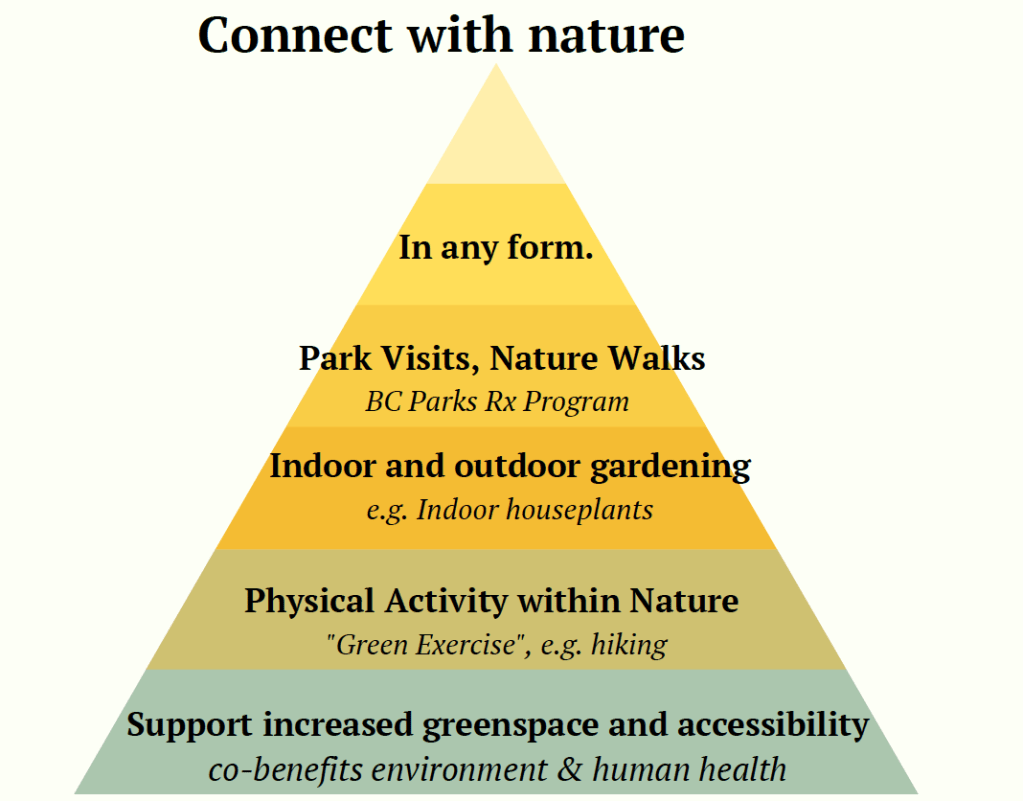
Movement to urban areas does not mean we cannot connect to nature, but rather, it means that we must move ourselves to create, find, and foster new ways to do so.
Frequency & “dosage” of nature
What is the right “nature dose?”
There is a growing body of evidence indicating that greater opportunities to connect with nature are associated with better health and well- being. However, there is less research that measures what amount of recreational or ‘purposeful’ time individuals need to spend to promote the associated health factors. To be introduced to this emerging concept, look below at two seminal studies that have focused on defining this relationship.
Recommendations:
- Spend at least 2 hours in nature/week [14]
- Set aside intervals of at least 20- 30 minutes [15]
Case Study: “Spending at least 120 minutes a week in nature is associated with good health and wellbeing” [14]
One of the first studies focused on defining optimal exposure-response dose that measured individual’s nature contact directly rather than focusing on the usual measurement of proximity to green space found that reporting good health and well-being was significantly greater when spending 2+ hours in nature/week.
Aim of Study: To improve our understanding of any exposure-response relationship between contact with natural environments and health, well- being.
Methods: Used data from large nationally representative sample in England. Direct nature exposure was defined in terms of self-reported minutes spent in natural environment in the last seven days.
Results:
- Intervals of how this time was achieved did not matter in this study
- Likelihood of reporting good health or high well-being became significantly greater with contact >120 mins.
- This positive association peaked at 200-300 minutes with no increased gain
Read this study: White, M. P., Alcock, I., Grellier, J., Wheeler, B. W., Hartig, T., Warber, S. L., Bone, A., Depledge, M. H., & Fleming, L. E. (2019). Spending at least 120 minutes a week in nature is associated with good health and wellbeing. Scientific Reports, 9(1), 7730.
Case Study: “Urban Nature Experiences Reduce Stress in the Context of Daily Life Based on Salivary Biomarkers” [15]
A seminal study, focused on describing the relationship between mental restoration from nature experiences (measured through physiological biomarkers) and the effective “nature dose” of time spent outdoors that brings a sense of connection to nature.
Aim of the Study: To improve our understanding of optimal “nature dose” that is applicable within the context of the unpredictability of daily life.
Methods: Over 8 weeks, 36 individuals living in urban areas were asked to have a nature experience in an outdoor place that brings a sense of connection for at least 3 times/week for 10 minutes or more.
It is unique in that participants were able to choose the time of day, duration and place for their nature experience, to make it applicable to daily life.
Results: Stress levels and cortisol levels were measured. Salivary cortisol was found to drop 21.3%/hr or greater after a nature experience in comparison to the hormone’s 11.7% diurnal drop. The most efficient nature dose was found to be greatest between 20-30 minutes.
Read this study: Hunter, M. R., Gillespie, B. W., & Chen, S. Y.-P. (2019). Urban Nature Experiences Reduce Stress in the Context of Daily Life Based on Salivary Biomarkers. Frontiers in Psychology, 10, 722.
Canada’s Parks Prescription Program
Canada’s first-ever evidence-based parks prescription program is Parks Rx, an initiative of the BC Parks Foundation.
This initiative is driven by health professionals with the goal of improving their patient’s health by connecting them to nature. Research shows that a written goal-oriented prescription is better at motivating patients’ behaviour than verbal advice alone. [16]
Highlights:
- PaRx is a simple, practical intervention that is free for physicians and patients to use
- You can begin prescribing nature today, no matter where your practice or patients are located
- Accessible handouts are available for patients regarding nature benefits for specific diseases (e.g., anxiety, CVD)
You can learn WHY and HOW you can begin prescribing time in nature to your patients today on the Parks Rx Program website linked below.
Introducing Dr. Melissa Lem
Founder of Canada’s PaRx Program, president-elect of the Canadian Association of Physicians for the Environment (CAPE), a recipient of the 2020 Joule Innovation Grant, and a Vancouver family physician and mother.
We had the opportunity to chat with her, and this is what she had to say:
“I regularly counsel patients, especially those with mental health concerns, to spend time in nature. Usually, this counselling takes place along with our discussion about other lifestyle interventions. I am currently working to determine best prescribing natures for nature, and which sorts of nature experiences are best suited to different populations, to allow us to pin more specific recommendations on how to counsel patients. Part of the reason why I’m working on a ParkRx is because I want to formalize the process more and provide tracking and incentives for patients that will increase their likelihood of adherence.”
— Dr. Melissa Lem, April 2020
“We wanted to formalize [connecting to nature] because in part, the evidence shows that writing something down increases the chances that the patient will be motivated to make that change.”
— Dr. Melissa Lem
References
[1] Cox, D. T. C., Hudson, H. L., Shanahan, D. F., Fuller, R. A., & Gaston, K. J. (2017). The rarity of direct experiences of nature in an urban population. Landscape and Urban Planning, 160, 79–84.
[2] Amid coronavirus threat, Americans generally have a high level of trust in medical doctors. (2020, March 13). https://www.pewresearch.org/fact-tank/2020/03/13/amid-coronavirus-threat-americans-generally-have-a-high-level-of-trust-in-medical-doctors/
[3] Nurses, Doctors and Scientists Are Canada’s Most Respected Professionals. (2017, June 15). https://www.insightswest.com/news/nurses-doctors-and-scientists-are-canadas-most-respected-professionals/
[4] Frank, E., Breyan, J., & Elon, L. (2000). Physician disclosure of healthy personal behaviors improves credibility and ability to motivate. Archives of Family Medicine, 9(3), 287–290.
[5] Thompson Coon, J., Boddy, K., Stein, K., Whear, R., Barton, J., & Depledge, M. H. (2011). Does participating in physical activity in outdoor natural environments have a greater effect on physical and mental wellbeing than physical activity indoors? A systematic review. Environmental Science & Technology, 45(5), 1761–1772.
[6] Mitchell, R. (2013). Is physical activity in natural environments better for mental health than physical activity in other environments? Social Science & Medicine, 91, 130–134.
[7] Pretty, J., Peacock, J., Sellens, M., & Griffin, M. (2005). The mental and physical health outcomes of green exercise. International Journal of Environmental Health Research, 15(5), 319–337.
[8] Van Den Berg, A. E., & Custers, M. H. G. (2011). Gardening promotes neuroendocrine and affective restoration from stress. Journal of Health Psychology, 16(1), 3–11.
[9] Blair, C. K., Madan-Swain, A., Locher, J. L., Desmond, R. A., de Los Santos, J., Affuso, O., Glover, T., Smith, K., Carley, J., Lipsitz, M., Sharma, A., Krontiras, H., Cantor, A., & Demark-Wahnefried, W. (2013). Harvest for health gardening intervention feasibility study in cancer survivors. Acta Oncologica , 52(6), 1110–1118.
[10] Larson, L. R., Jennings, V., & Cloutier, S. A. (2016). Public Parks and Wellbeing in Urban Areas of the United States. PloS One, 11(4), e0153211.
[11] Sturm, R., & Cohen, D. (2014). Proximity to urban parks and mental health. The Journal of Mental Health Policy and Economics, 17(1), 19–24.
[12] Lee, J., Park, B.-J., Tsunetsugu, Y., Ohira, T., Kagawa, T., & Miyazaki, Y. (2011). Effect of forest bathing on physiological and psychological responses in young Japanese male subjects. Public Health, 125(2), 93–100.
[13] Park, B. J., Tsunetsugu, Y., Kasetani, T., Kagawa, T., & Miyazaki, Y. (2010). The physiological effects of Shinrin-yoku (taking in the forest atmosphere or forest bathing): evidence from field experiments in 24 forests across Japan. Environmental Health and Preventive Medicine, 15(1), 18–26.
[14] White, M. P., Alcock, I., Grellier, J., Wheeler, B. W., Hartig, T., Warber, S. L., Bone, A., Depledge, M. H., & Fleming, L. E. (2019). Spending at least 120 minutes a week in nature is associated with good health and wellbeing. Scientific Reports, 9(1), 7730..
[15] Hunter, M. R., Gillespie, B. W., & Chen, S. Y.-P. (2019). Urban Nature Experiences Reduce Stress in the Context of Daily Life Based on Salivary Biomarkers. Frontiers in Psychology, 10, 722.
[16] Swinburn, B. A., Walter, L. G., Arroll, B., Tilyard, M. W., & Russell, D. G. (1998). The green prescription study: a randomized controlled trial of written exercise advice provided by general practitioners. American Journal of Public Health, 88(2), 288–291.
4: Evidence to Action
This section discusses ways to take action:
- for yourself,
- for your community,
- and for the environment
Take Action, for yourself
UBC Medical Student Competency:
- Maintain personal health and well-being such that the health care that one provides is sustainable
- Use appropriate self- care techniques or strategies to alleviate the physical and emotional stresses inherent in the medical profession.
Maintaining your own personal well-being amidst a world facing a climate crisis and a demanding profession is of the utmost importance. Medical students and physicians are not protected from the mental and physical impacts of our rapidly changing climate. Within the healthcare sector, rates of depression and physician burnout are already alarmingly high.
To work towards fostering confident, supported, and empowered medical students and physicians utilizing nature connection as a critical strategy to support personal well-being through and work towards a sustainable and resilient practice long term.
Begin by:
- Finding ways that you can meaningfully connect to nature.
- Advocating for increased opportunities to connect with nature in your practice.
- Advocate for increased access to green space in hospitals and clinics
- Communicate that work breaks can involve taking a moment to connect to nature
Take action, for your community
UBC Medical Student Competency:
- Assess a patient’s ability to access various health care delivery and social services, and identify barriers to accessing health care and social services with considerations given to disabilities, under- serviced and marginalized populations, rural populations and language barriers.
As highlighted in Topic 1: Climate Change & Population Health, “there is substantial research that emphasizes that the burden of climate change will be disproportionately felt by low-income and marginalized populations.” [2,3]
Accessibility to green space has been found to be disproportionately lower in low- income and marginalized communities [4, 5], despite these being the areas experiencing the greatest health inequalities. [5] Research has found that populations that are exposed to the greenest environments also have the lowest levels of health inequality related to income deprivation. [5, 6, 7, 8]. Specifically, good access to green space was found to attenuate negative mental well-being, and all cause and circulatory mortality in economically deprived areas. [8,9]
Consider barriers to vulnerable communities may face when connecting to nature:
- Lack of surrounding green spaces (e.g. certain urban areas, lower income neighbourhoods)
- Lack of transportation methods (e.g. children and youth, people with disabilities, lower-income families)
- Lack of time (e.g. single mothers, lower-income families – inability to take time off)
Begin by:
- Advocating for increased neighbourhood green space, especially amongst the most vulnerable communities.
- Advocate for increased quality and quantity of parks. Recall from the last section, proximity, and quality and quantity of parks significantly associated with increased mental health scores, and increased quality of life in urban areas. [4, 10, 11]
- Advocate for funding to subsidize activities/forms of connecting to nature to increase accessibility.
Take action, for the environment
The inextricable links between the health of our community and the health of our environment have become increasingly clear. Advocating for nature-based solutions such as motivating patients to utilize connecting to nature as a health promotion strategy, also has benefits for the environment in terms of climate change mitigation and adaptation. [12] Further, it has been found that connecting to nature promotes pro-environmental behaviours. [13, 14, 15]
Begin by:
- Advocating for increased green space for climate mitigation and adaptation.
- Utilizing the practical intervention of nature connection as a health strategy.
- It has been shown that connecting to nature increases pro-environmental behaviours
Learn more:
- How green space offers co-benefits to climate change, mitigation, adaptation and human health.
- How connecting to nature promotes pro-environmental behaviours.
“Bold action must be taken to conserve, restore and sustainably manage nature for climate mitigation and adaptation. The time to act is now. We will succeed by working together: reconnecting people and nature to implement… a secure [and] sustainable future for all – both now and for generations to come.” [16]
– The Canadian Public Health Agency
References
[1] Weerasuriya, R., Henderson-Wilson, C., & Townsend, M. (2019). Accessing Green Spaces Within a Healthcare Setting: A Mixed Studies Review of Barriers and Facilitators. HERD, 12(3), 119–140.
[2] Organization, World H. Protecting Health from Climate Change: Vulnerability and Adaptation Assessment. World Health Organization, 2013.
[3] Intergovernmental Panel on Climate Change (IPCC), 2014.
[4] de Vries, S., van Dillen, S. M. E., Groenewegen, P. P., & Spreeuwenberg, P. (2013). Streetscape greenery and health: stress, social cohesion and physical activity as mediators. Social Science & Medicine, 94, 26–33.
[5] Beyer, K. M. M., Kaltenbach, A., Szabo, A., Bogar, S., Nieto, F. J., & Malecki, K. M. (2014). Exposure to neighborhood green space and mental health: evidence from the survey of the health of Wisconsin. International Journal of Environmental Research and Public Health, 11(3), 3453–3472.
[6] Ward Thompson, C., Aspinall, P., Roe, J., Robertson, L., & Miller, D. (2016). Mitigating Stress and Supporting Health in Deprived Urban Communities: The Importance of Green Space and the Social Environment. International Journal of Environmental Research and Public Health, 13(4), 440.
[7] McEachan, R. R. C., Prady, S. L., Smith, G., Fairley, L., Cabieses, B., Gidlow, C., Wright, J., Dadvand, P., van Gent, D., & Nieuwenhuijsen, M. J. (2016). The association between green space and depressive symptoms in pregnant women: moderating roles of socioeconomic status and physical activity. Journal of Epidemiology and Community Health, 70(3), 253–259.
[8] Mitchell, R., & Popham, F. (2008). Effect of exposure to natural environment on health inequalities: an observational population study. The Lancet, 372(9650), 1655–1660.
[9] Mitchell, R. J., Richardson, E. A., Shortt, N. K., & Pearce, J. R. (2015). Neighborhood Environments and Socioeconomic Inequalities in Mental Well-Being. American Journal of Preventive Medicine, 49(1), 80–84.
[10] Larson, L. R., Jennings, V., & Cloutier, S. A. (2016). Public Parks and Wellbeing in Urban Areas of the United States. PloS One, 11(4), e0153211.
[11] Sturm, R., & Cohen, D. (2014). Proximity to urban parks and mental health. The Journal of Mental Health Policy and Economics, 17(1), 19–24.
[12] Public Health Agency of Canada. (2020, March 19). Commentary – Climate change, health and green space co-benefits – Canada.ca.
[13] Capaldi, C. A., Dopko, R. L., & Zelenski, J. M. (2014). The relationship between nature connectedness and happiness: a meta-analysis. Frontiers in Psychology, 5, 976.
[14] Mayer, F. S., Frantz, C. M., Bruehlman-Senecal, E., & Dolliver, K. (2009). Why Is Nature Beneficial?: The Role of Connectedness to Nature. Environment and Behavior, 41(5), 607–643.
[15] Martin, L., White, M. P., Hunt, A., Richardson, M., Pahl, S., & Burt, J. (2020). Nature contact, nature connectedness and associations with health, wellbeing and pro-environmental behaviours. Journal of Environmental Psychology, 68, 101389.
[16] Canadian Public Health Agency, Addressing the Ecological Determinants of Health https://www.cpha.ca/sites/default/files/assets/policy/edh-discussion_e.pdf

